Pages

Showing posts with label winter garden. Show all posts

Saturday, February 16, 2019

Winters of my discontent

Gardening is a seasonal activity. One of its great joys is how it puts me in touch with the seasons in a deeper way than wondering whether I need a coat or an umbrella each day. (Note: I lived in Portland for 14 years. Umbrellas are for wimps and Californians--unless it’s monsoon season). We gardeners are good at romanticizing the changing of seasons, the rhythms of the gardening life that mark the passage of time. But the cold truth is, winter sucks. At least it does here in the land of frozen ground and snow that is occasionally measured in feet. For me iIt’s OK through about Christmas, because I’m tired from fall harvesting and cleanup and soil prep and tucking the roses in for their winter sleep. (Another note: Roses in Flagstaff require a lot of pampering. I practically have to read them bedtime stories, and still about half of them die.) It’s nice to spend weekends reading, writing, sleeping, and eating too many carbs with no guilt about weeds that need pulling, manure that needs spreading, or tomatoes that need harvesting and processing. By January, though, the lounging around is starting to get boring.

Is it time to plant seeds yet?

No, it's too early.

Can I shovel manure?

No, the garden is covered with snow.

Can I plant something?

No, the ground is frozen.

Can I buy something?

No, it'll die before you can plant it. Besides, the only things in the garden centers are junipers, and your husband is allergic to junipers.

Maybe he can just take Benadryl?

No.

Can I prune the roses?

No, you can't do that till the forsythia blooms.

Whyyyyyyy? WTF is so special about “when the forsythia blooms?”

Because we say so, say the experts with their prize-winning blooms and snooty British accents.

In fact, for most of the winter my inner monologue sounds like a mother talking to an especially whiny toddler. Or like this:


And so it goes, through January (long, cold, and boring), February (short, cold, and boring) and into March, when the ground might actually thaw, pansies might actually show up at Home Depot, and I might spend every day refreshing the National Weather Service page for Flagstaff, hoping to see a sunny day that doesn’t involve 40 mph wind gusts. As I write this, it’s mid-February, and I’m cold and bored. There’s an inch or two of snow on the garden, the ground is frozen solid, and my dogs have resorted to bringing icicles in the house to chew on. It wasn’t always like this.

I started gardening as a small child in Tracy, near the San Joaquin Delta in California. We had winter there (contrary to the popular belief of everyone who didn’t grow up in the Golden State), but it consisted of “cold” days (highs in the 50s) with a little fog or rain or wind on occasion. My mother didn’t garden much in the winter, so mostly neither did I. I do remember someone (probably Mom) telling me you could grow carrots in the winter. So one bright winter day, I seeded two long rows of carrots in the backyard. I don’t know how old I was but probably around ten or so. I do know it was an age that predated common sense. How do I know this? Because I chose to plant those rows of carrots… directly under the clothesline. Needless to say, we didn’t have any carrots that year. (Note for those under 35: A clothesline was a long piece of cord tied between two poles and used for hanging laundry. It’s what we had before dryers, and we liked it. Now get off my lawn.)

I puttered around at gardening here and there (Vancouver, Washington, and Dalton and Ringgold, Georgia, to be specific), but I didn’t start gardening in earnest till we moved to Portland, Oregon, in the mid-1990s. There winter was loooooonnnnnnngggggggg, dark, and very, very wet. My first winter in Portland, the rain started on Labor Day and didn’t stop for more than a day or two at a time till June. It was excruciating. On the rare sunny winter day in Portland, I’d clomp outside in my gardening boots, desperate to see some sign of spring--and promptly sink into the mud. If I walked on the lawn, I left big, ugly mudprints across it. But I’d do it anyway, because even approaching middle age, I still had no common sense. I started getting interested in digital photography in the mid-2000s, so I’d take my camera outside in the mud and try to find something pretty to photograph. In Portland. In January. That’s when I fell in love with hellebores, the only flower to be found on those short, dark, dreary days.


A couple of years after the digital camera, I got a greenhouse in an attempt to preserve both my plants and my sanity during Portland winters. Then I spent winter weekends planting flats of seeds and tending potted citrus trees while listening to the rain rattle against the polycarbonate roof of the greenhouse. The greenhouse and the power to heat it weren’t cheap, but they were probably cheaper than therapy and antidepressants, and they cut down considerably on my whining.

In 2010 we decamped for the San Gabriel Valley in Southern California. For the first year or so, I was a kid in a candy store. I’m pretty sure I bought every citrus tree in a 25-mile radius of our house: lemons, limes, oranges, blood oranges, kumquats, even mandarinquats. Yes, mandarinquats are an actual thing. They’re even edible, though “mandarinquat” sounds like a pesticide. For the first time since I was a kid, I could garden in the winter--actually garden, in an actual yard, in actual soil. And a good thing too, because I sure as hell couldn’t garden in the summer unless I wanted to die of heatstroke. You try digging in 114-degree heat.

And so I could be found planting roses in January, harvesting lettuce in February, and juicing oranges from Christmas till Easter. It was blissful. I no longer dreaded winter, though I could often be found trying to dig and plant and weed at twilight in order to wring every last moment out of a short winter weekend day. I wouldn’t give up till well past the time when it was too dark to tell a dandelion from a black widow. Apparently I still had no common sense.

And now I find myself in Flagstaff, where the weather tries to thwart me at every turn. Snow, frozen ground, monsoon rains, howling wind, and dry springs that kill seedlings and nurture wildfires. Most of the time I love it here… but this is not that time. This is the time when I’m done with the cold and snow and frozen ground and bloody nose from dry air and covering stuff with frost blankets and sliding on ice to get to the damn compost heap. Done with my gardening being limited to babysitting my houseplants and spraying my lemon tree for scale. Yes, I have a lemon tree. It’s in my living room from October through May. Thanks to my husband hand-pollinating it with an artist’s brush, it’s even making lemons.


Soon the daffodils will break ground, buds will swell on the apple trees, I’ll be able to take the 2 feet of soil and straw off the roses, and my gardening options will no longer be defined by Grumpy Cat. But till then I’ll make due with seed catalogs and planning next year’s garden and buying roses from big box stores when I find myself in Phoenix, then bringing them back and trying to keep them alive in my garage till April. Yep, you guessed it, I still have no common sense.

Sunday, December 30, 2018

Winter wonderland

It finally feels like winter here in the Arizona highlands: snow, highs in the 20s, wind chill in the negatives... good times. I love taking pictures of the garden in snow, because the snow hides the weeds transforms the landscape. I've been working on my annual report post (look for that one tomorrow), so I've been going through pictures of the garden throughout the year. It's hard to believe that this: 


Now looks like this: 

Or this:


Now looks like this:


One of the many things I love about gardening is that it makes me more attuned to the seasons: the subtle shift from spring to summer, summer to fall. Fall to... the sudden dumping of a pile of cold white stuff all over everything. Yeah, I'm not a big fan of winter. I do love the peacefulness and beauty of the garden in snow. Soon it will be time to start seeds, transplant, mulch, and wage war on the grasshopper horde. In the meantime, though, I'll savor the beauty all around me. 


Thursday, March 1, 2018

Winter finally put in an appearance

After being AWOL since last year, winter finally showed up in the form of a few inches of soft, powdery snow. The last morning in February was the kind of snowy morning I love: still, peaceful, not too cold, with snow falling softly and transforming the sad, scraggly winter garden into a wonderland. Too bad I had to go to work. I did take a few minutes to snap some pictures, since the way this year is going, this could be our only real snowfall. I'm glad I got those pics, because the snow was mostly gone by the time I got home that afternoon, the snow was mostly gone. Beauty is so often transitory, especially in a garden.

Near the front door:


Front side yard:


The pond! Part of my motivation for building a pond was the thought of seeing it surrounded by snow. And here it is:


Looking toward the potager:


This post is backdated, because as usual I didn't get around to posting the pictures in a timely manner. It's now March 9, the snow is gone, and the temp today is supposed to be pushing 60. What lovely gardening weather! Too bad I have to work.

Monday, January 1, 2018

Pond is for the birds

 Happy New Year! I've been traveling and lounging, because that's what one is supposed to do during the holidays, so I don't have any exciting gardening updates. What I do have are birds. Lots and lots of birds. This is our first winter with our pond, and apparently the feathered population of Flagstaff has decided it's a giant birdbath. We have flocks of birds hanging out in our front yard, and every morning, they're in the pond, bathing and drinking and being generally hilarious. We love the entertainment, though our driveway is now festooned with a fine glaze of bird droppings. Ah, well: everything has a downside.

Another downside: it's hard to get decent pictures of our feathered visitors, because as soon as they see me come out the front door, they scatter. So I've started taking pictures of them through one of our living room windows. The only problem is, our living room windows are dirty. I haven't cleaned them properly in well over a year, because I'm lazy. So my bird pictures aren't as sharp and clear as they could be if I put down the camera and cleaned the damn windows. Ah, well. No one ever said this blog was operated by National Geographic.


All of the pictures above were taken yesterday morning. This one was taken in early November. We came back from a walk to find a roadrunner drinking from the pond. An honest-to-goodness road runner. No sign of a coyote or any packages from Acme, thank goodness. He fled at sight of us, but we were able to get a couple of pics thanks to a good zoom lens.


So far we're loving the pond. It's a bit of work, but it's kind of fun to have the local avian spa. I hope the birds hang around for grasshopper season. I need all the help I can get with those things.

Tuesday, December 26, 2017

Winter has been canceled

Today is Boxing Day. You know, the day after Christmas. A few days after the Winter Solstice. Late December. According to my calendar, it's supposed to be winter. And in case you forgot, I live in Flagstaff. 7000 feet elevation. Snow. Cold. One of the places in Arizona that's supposed to get actual winter. Note for Phoenicians and Southern Californians: 60F is not a winter temperature--or it isn't supposed to be. According to the National Weather Service, it's 58 today. I just came in from the garden, and I was comfortable in a short-sleeved t-shirt, so it's probably more like 60. On December 26. We got a whole half inch of snow a few days ago, and that's the closest we've come to anything resembling winter. I'm certainly not complaining - I'd much rather shovel manure than snow - but it's pretty weird. 

Here's a scene from my garden as of a little while ago: 
For contrast, here's the same area on Christmas Day last year: 
As a transplanted Californian, I prefer today's weather, but it's pretty bizarre. It feels like early October--or SoCal. Here are a few scenes from around the garden on this freakishly warm winter day: 

Side bed along the driveway: 


The pond:


Snapdragons and pansies in pots against the south wall of the house. I got these virtually free from my local big box garden center at the end of the season, and I'm experimenting to see if they'll winter over here. The area by the south wall of the house is at least a zone warmer than the rest of the yard, so I'm hopeful.  
This is the area I'm currently transforming from field of tumbleweeds and pokey things to a garden, preferably one that won't attack me when I walk through it (Question of the day: Why are half the wild plants in deserts armed with pokey things?) It isn't much to look at now, but I hope to use this picture as a "before" picture next summer to show how much it's improved. 


Tomorrow we're supposed to take a road trip in the desert. When we planned this, we thought it would be a nice escape from the snow and cold. I just checked the weather forecast for Yuma, our first stop, and it's only supposed to be about 15 degrees warmer than here. I'm so confused. 

Tuesday, February 28, 2017

Find (or make) your microclimates

File_001.jpegMy complaints about the weather are a standard theme on this blog. I’m a transplanted Californian; winter confuses me. Now that I live on Hoth in Flagstaff, I’ve had to learn about stuff like snowblowers, de-icers, negative temperatures (what the !@#$% kind of hell are those?) and microclimates. That last one is especially important if I want to ripen tomatoes or keep anything alive through the winter. So I’ve spent lots of quality time observing in my garden to see where the warm spots (not many), the windy spots (the entire yard), the extra cold spots (most of the yard), and the dry spots (also the entire yard) are. This kind of close observation is part of what makes gardening such a fascinating hobby. The really ambitious can go a step further and create microclimates. I’m going to try that this year for tomatoes, since I get tired of having to ripen my entire tomato crop in the house every fall.

So, how do you find or create microclimates in your yard? I’ll share a few articles on the topic, then give you one of my shortcut methods for finding the warmest spots.


Microclimates can make the difference between a beautiful specimen and yet another dead plant. In my yard, my front porch faces south and includes lots of concrete plus the giant heatsink known as my house. We’ve had temps down to -1F (or as I refer to any temperature below 0, !@#$% freezing), but I still have pansies and snapdragons alive there--in containers, no less. I’m guessing that means my porch is more than a full zone warmer than the parts of the front yard that are further away from the house.

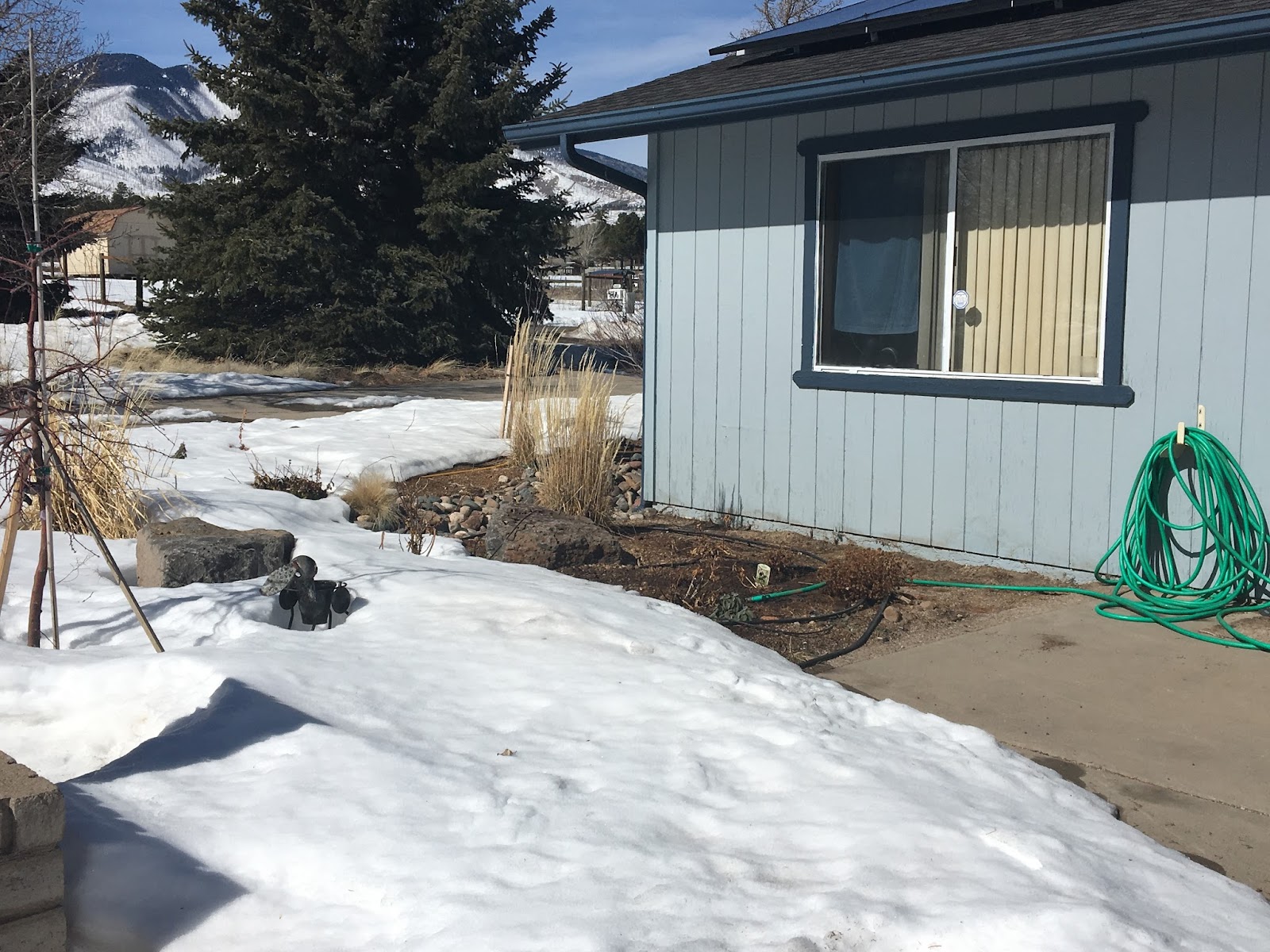
And that brings me to one of the quickest ways that those of us in snow country can identify at least the warmer and colder microclimates in our yards: observe and take pictures of the snow melt. We got about 2 feet of snow last month (“What the !@#$%?,” says the Californian) with drifts as deep as 4 feet. I spent most of the 2+ weeks it was on the ground scowling and snarling at it. That didn’t make it melt faster, but other factors besides my bad temper did have an effect. Take a look at this picture, taken about 3 weeks after the snowfall:

File_000.jpeg

That’s a great visual demonstration of house-as-heat-sink creating a warm microclimate. The remaining snow in the picture is a few inches deep, and over by my new potager, the snow was about 7” inches deep. How do I know this? Because I sunk into it every. damn. time I carried something to the compost bin. But I digress. My point is that taking pictures of the snow melt around your house can give you a visual reminder of where the warm spots are, so you can take that into account as you plan your garden. You could also note the reverse, where the snow sticks around until you want to take a flamethrower to it to make it go away already. Those are the places you don’t want to plant anything that’s only borderline hardy in your zone.

I went a step further and tried to note where the biggest drifts were, because that tells me something about the wind patterns in the yard. That might be useful information too--if I can ever plant anything. As I write this, my garden is once again buried in snow. !@#$%.

Sunday, January 22, 2017

Winter garden--now with 50% more snow!

We are just starting the third of three storms in a row to hit Flagstaff. There's about a foot of snow on the ground now, but the pictures below were taken when there were only about 6 inches. I'm not really a winter person, but I love how grasses and seed heads look against the snow. The winter garden is all about shape and texture and contrast. Now that I live where winter is a thing that keeps me from gardening for months, I'm trying to get better at finding beauty in the garden in all seasons. It's not too difficult on peaceful mornings after a snowfall.

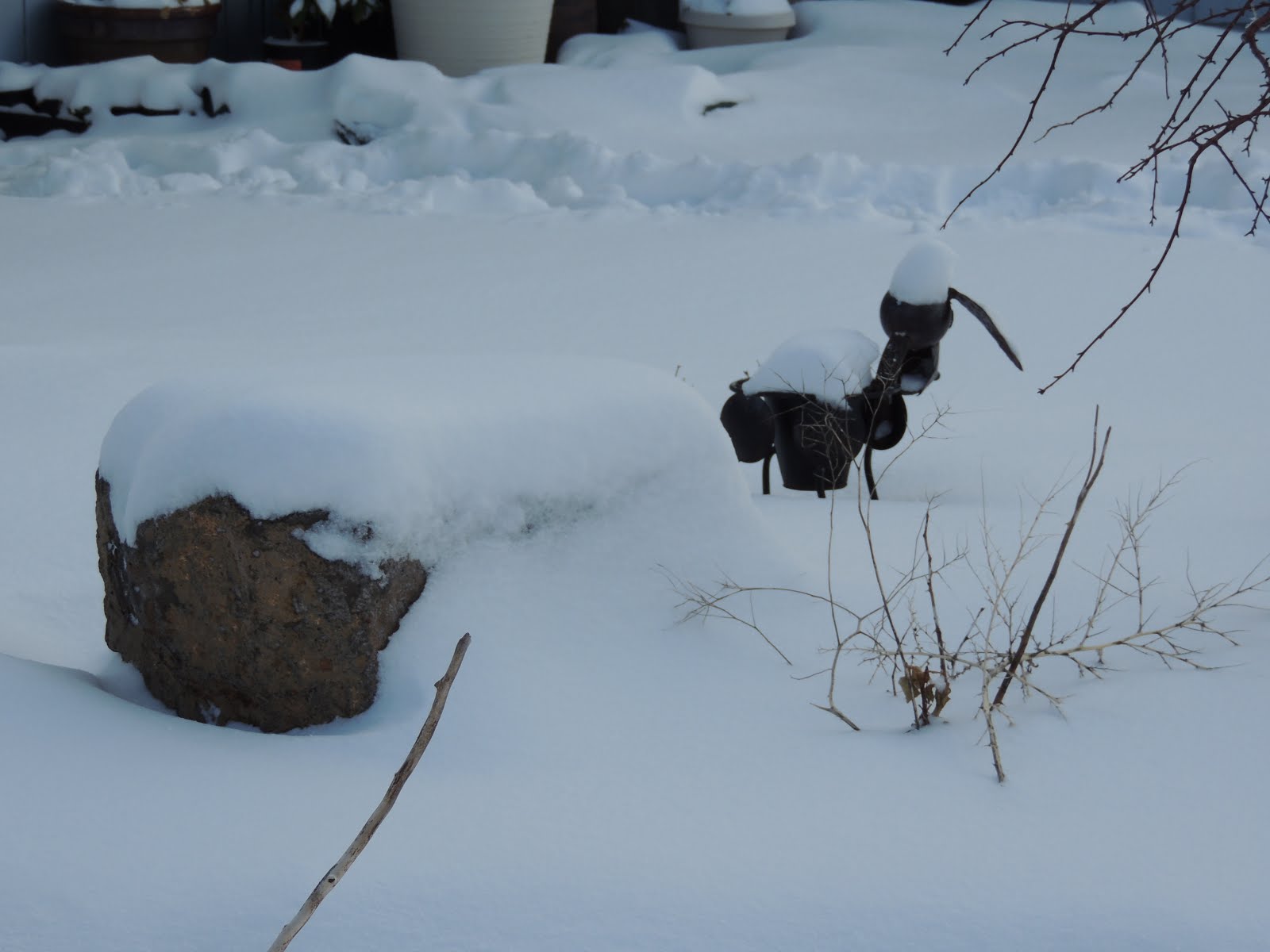
My favorite bit of yard art looks even more whimsical in the snow:

Mums peeking through their snowy blanket:

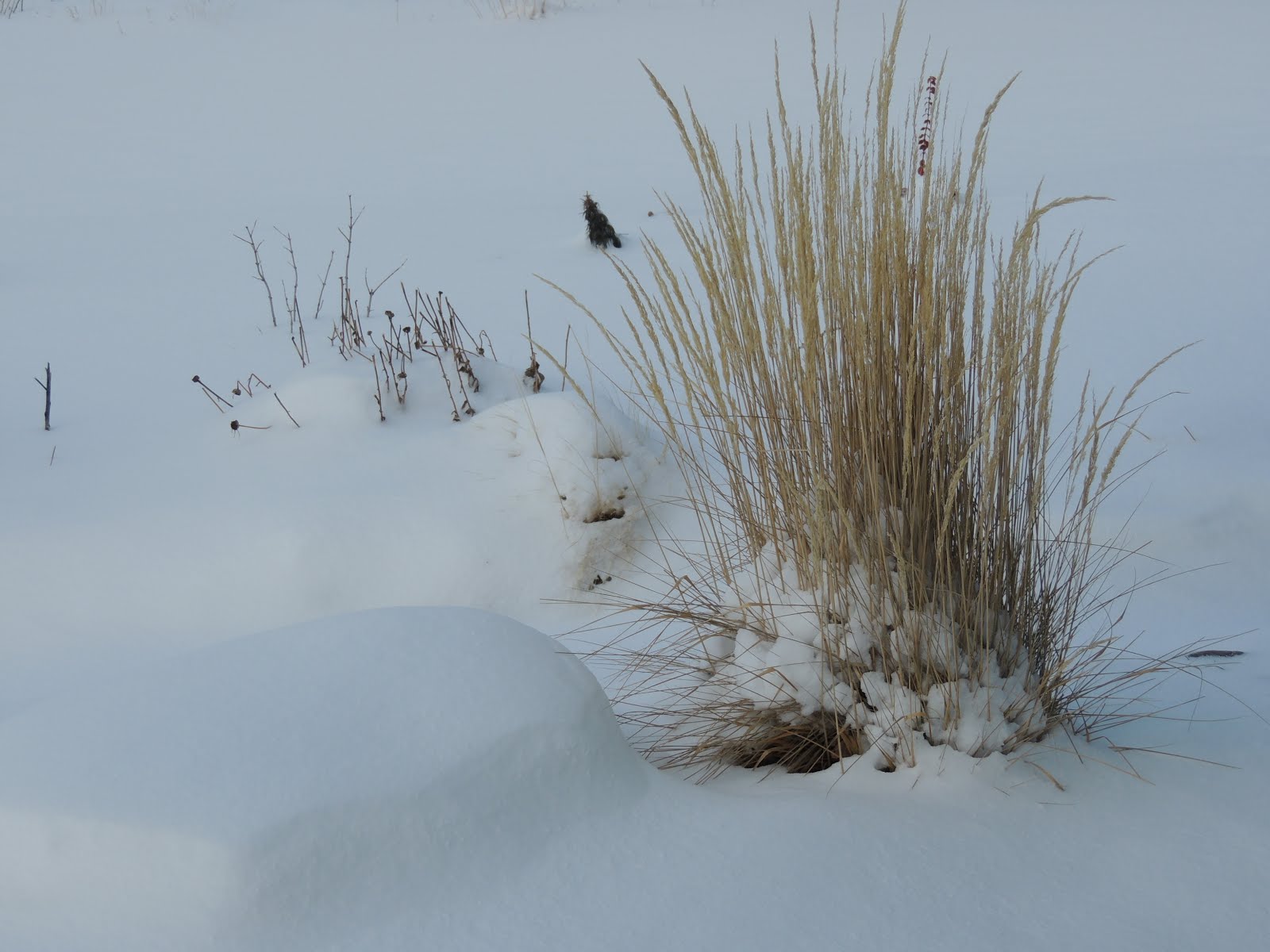
Ornamental grasses and a mostly-covered boulder:

More mums:

Grasses and a softened boulder:

I think this is some kind of spirea:

Native grass:

Another boulder and the back side of my favorite yard art:

For some reason, this corner of the yard makes me think of Frost's "Stopping by Woods." There's a dry creek bed flowing through the evergreens and cottonwoods, but the snow has reduced it to white undulations.