Pages

Showing posts with label frugal gardening. Show all posts

Saturday, March 10, 2018

Today's estate sale bargains

Daylily 'Custard Candy'. Image from Wikimedia Commons.
 If you know me at all or have read this blog much, you know I'm a bargain hunter (see my series of posts on frugal gardening for evidence). I find some of my best non-plant bargains at garage and estate sales--pots and other containers, garden tools, garden art, and other odds and ends that make this gardener's heart happy. Every now and then, I score plants that way too, usually pathetic-looking ones well on their way to that great garden in the sky. As you also know if you read this blog at all, winter is not my favorite time of year. I've probably spent about a third of my posts complaining about the cold, complaining about the snow, and complaining that I can't garden because of the cold or the snow. Time to add another complaint: there are almost no garage sales in Flagstaff in the winter. Today, though, it seemed like garage sale season might be starting. I found three--count 'em, three!--estate sales, and one had a big ol' pile of pots and other gardening paraphernalia. $10 later, my pickup bed was full. Among the various containers, bags of soil, moss, and other stuff, I found several boxes of bulbs and bare-root plants. I figured they were from last spring and probably DOA, but I took them, since they were part of my $10 pile.

When I got them home, I discovered that they are from 2016, or so the mailing label on the box said. So they're pretty much a lost cause, right? Might as well pitch them onto the compost heap and move on with my life, right? Sorry, but that makes too much sense. Instead, I spent the last hour planting every one of them that wasn't completely crispy. And it's raining, so I slogged around in the rain to do this. Yes, I am insane.

Here's the haul:

Daylilies
  • Dragon's Eye
  • Mildred Mitchell
  • Custard Candy (the one pictured above)
Roselilies (Note: I'd never heard of roselilies before. Turns out they are double-flowered, pollen-free Oriental lilies, and they are gorgeous. See this article from Greenhouse Product News for more info.)
  • Natalia
  • Carolina
  • Elena
Hardy gladiolus (I didn't know about these either. I've mostly avoided planting glads in Flagstaff, because I'd have to dig them up every winter, and our gale-force winds would blow them over five minutes after they started blooming. Hardy glads are shorter with smaller flowers (a better choice when you live in a wind tunnel) and are hardy to zone 5 with winter mulch. Missouri Botanical Garden has a page about them.)
  • Nathalie
  • Elvira
  • Impressive
  • Halley
  • Atom
  • Mirella
I'll report back in about June on whether any of these actually grew. Even if they don't, I got some exercise and discovered some bulbs I'd never heard of. Not too bad for a rainy winter day.

Sunday, September 10, 2017

Cheapskate gardening 3: Foraging

The first two episodes of the Cheapskate Gardening miniseries (Propagating plants and How to get plants cheaply) focused on actual gardening. Now that it’s the height of harvest season--at least here in the Northern Hemisphere--let’s talk about foraging, also known as cheapskate harvesting. Why forage? Because you can chow down on this sort of yumminess:


That's a jar of apple pie filling on the left. I canned it around this time last year (using this recipe from the National Center for Home Food Preservation), when my husband brought home two huge boxes of foraged apples. There's a dentist's office here in Flagstaff with several large apple trees on the property. They don't use the apples (maybe apples have the same effect on dentists as they do on doctors) and like to have people pick them so they don't fall and clutter up the property. So my husband showed up with a ladder and a couple boxes, and the rest is sugary, cinnamon-y, gooey history. The pic on the right is half of the apple crisp I made yesterday (using this recipe from Betty Crocker) with a quart of the aforementioned pie filling. It took about 5 minutes to assemble (thanks to the apples being already prepared) and is heavenly. 

Now that you know why you should forage, let's talk about where and how.  

Foraging in the wild

This is what most people think of when someone says, "foraging"--wandering around in the forest like Euell  "Many parts are edible" Gibbons, tasting foul-looking plants until you end up needing a Poison Control Center and/or a stomach pump. You can avoid that scenario by learning what's safe to eat in your area. To do that, check out one of the many books available on foraging. Your local library probably has some, or you can search Amazon. Here are just a few of the zillion results one gets when searching Amazon Books for, "foraging." 
You get the idea. There are tons of books about foraging in just about any region of the US (and I imagine there are plenty on foraging in other countries too; I'm just less familiar with those, since I have no money to travel, because I spend all my money on plants). 

I don't do a lot of wild foraging, but when I do, it's relaxing and fun (and in the case of wild blackberries, delicious). It's an excuse to get out in nature, get some exercise, and come back with food. What's not to love?

Here are a few tips to get you started: 
  • Know what you’re picking. If you can’t identify it, don’t eat it! That's especially true of mushrooms, but plants can mess you up too, and I hear stomach pumps are no fun. Take a class or a guided hike; ask about those at your local arboretum, ranger station, or nature center. Definitely get a guidebook for your region. Foraging is no bargain if it sends you to the hospital or the funeral home. 
  • Obey all laws. Know what you’re allowed to pick and from where. Foraging is, as far as I know, illegal in national parks. Rules for national forests, BLM land, and other public land can vary by location and by the agency administering the site. Check online or contact a ranger station or agency office to learn the rules. 


Foraging in civilization

Foraging possibilities abound in cities, suburbs, and rural areas. Lots of people have fruit trees that produce way more than they can use. Edible stuff--especially old fruit trees and blackberries--grow in vacant lots and on abandoned properties. And some ornamental garden plants have edible parts. In rural areas, sometimes you can ask to glean in the fields after the harvesters come through (My dad used to do that in the Central Valley in California when I was a kid. That's how I learned to can tomatoes: Dad would bring home a giant box of them, usually dead-ripe and needing immediate processing. Mom had to work, so I learned to can by the time I was about 12. In a house with nothing more than a swamp cooler for A/C. In the summer. When it was usually over 100 degrees. Uphill. Both ways.)

A great book for the beginning suburban forager is Backyard Foraging: 65 Familiar Plants You Didn't Know You Could Eat by Ellen Zachos. Her book will teach you what's edible in your yard and your neighborhood. Did you know you can eat your day lilies? And quite a few weeds? And think how satisfying it would be to chomp down on weeds--the gardener's ultimate revenge. Now if only I could stomach the thought of eating grasshoppers...


Another resource is a great post from Gayla Trail's You Grow Girl blog on foraging for free fruit. And if you're wondering where to go to forage in your neighborhood, you guessed it: there's an app for that. Check out Ripe Near Me. You might also check out your local Craigslist or Facebook gardening group. Someone might be selling or giving away their excess produce.

Here are a few tips for foraging in not-so-wild places:

  • Respect private property. Sometimes you can find great foraging on abandoned properties. Around here there are old apple trees all over the place (like at the aforementioned dentist's office), and they keep pumping out apples for decades. Lots of times, homeowners have fruit trees that make more fruit than they can use. They're often happy to have someone pick it, in part because unused fruit makes a giant mess when it falls from the tree and then becomes a yellow jacket magnet. But don't just stroll onto someone's land. Ask permission. 
  • Offer to barter if you're asking to pick from someone's tree. You could offer a jar of home-canned applesauce made with the apples they let you pick or some produce from your garden. Or you can offer labor, like picking some for them or cleaning up the fallen fruit around the tree (note: people with health issues may especially appreciate your help. Imagine how frustrating it would be to see a tree full of  beautiful apples but be physically unable to pick them). Be careful eating fallen fruit--it's usually either rotten or infested with something--but it can make great compost or livestock feed.
  • If you do pick from someone else's garden, treat their trees and plants gently so you don't cause damage. 
  • Avoid foraging from busy roadsides where the food likely will be contaminated by pollution from car exhaust or herbicides. 

Foraging fall décor

Pumpkins and fancy (or funny-looking) winter squash will start showing up in stores and on front porches soon (seriously--there are Halloween decorations in the store already. Sheesh, people, it isn't even technically fall yet!) I'll let you in on a little secret: these are edible. And doctored up with a sufficient amount of butter, sugar, and cinnamon, they are delicious. 

Here are a few tips for acquiring and processing Jack O'Lantern and his relatives: 
  • This one's obvious, but if you like to decorate with squash and pumpkins, eat them before they rot. How long you can keep them on your porch before they rot will depend on your climate. If they freeze and thaw, they deteriorate quickly (gotta love those 40-degree daily temperature swings here in Flagstaff). If the weather is warm, they'll rot quickly. Just keep an eye on them and be sure to butcher 'em before they get nasty. 
  • Hunt for bargains on or after Halloween*. Last year I scored a cool, giant white pumpkin at Home Depot on Halloween for $5 (original price: $20; it's the big thing at the far left in the picture above). Supermarkets and pumpkin stands often sell (or sometimes give away) their pumpkins the day after Halloween. All pumpkins are edible, but the big carving pumpkins aren't the best for eating. Look for the smaller pie pumpkins if you can find them. The red Cinderella pumpkins are getting more popular, and they are great for cooking. So are some of the weird warty pumpkins. All pumpkins and winter squash have edible seeds too--and you can save some to grow next year if you have the space. I currently have 2 enormous vines started from the seeds I got from that huge white Home Depot pumpkin. 
  • Ask your neighbors if you can have their pumpkins and winter squash. (Note: don't eat the carved ones--though they are fine for livestock feed.) Then take them a warm loaf of pumpkin bread as a thank-you. 
And if you've never cooked with fresh pumpkin or winter squash, check out a post on my old garden blog on how to prepare them. I puree them and freeze the puree to use in recipes. It usually contains a little more water than canned pumpkin, so I adjust recipes accordingly or let the puree drain in a colander for a bit before measuring. Oh, and in case you didn't know: pumpkin and winter squash are generally interchangeable in baking. In fact, what we know as canned pumpkin actually isn't pumpkin: it's a winter squash similar to a butternut. I know, I know - the label says, "pumpkin." Damn Libby and their #alternativefacts.

So there you have it: 3 ways to get some free or low-cost produce. May your foraging be fruitful!


------------------- 
* The pedants in the crowd are probably arguing that acquiring squash from a store doesn't meet the literal definition of foraging ("the acquisition of food by hunting, fishing, or the gathering of plant matter," according to dictionary.com), but since pedantry only puts food on the table if you're an academic, we'll ignore them. Hmm, wait, *I'm* an academic. Maybe I should rethink that. 


Saturday, September 2, 2017

Cheapskate gardening 2: How to get plants cheaply (or even free)

In my first cheapskate gardening post, I wrote about propagating plants and included lots of links to online resources to help you get started. In this post, I’ll talk about other ways to save money on plants.

Get ‘em on sale (or free!)

Here in the land of early frosts and negative winter temperatures, the big box stores and nurseries are already starting to clear out their stock, so we cheapskate gardeners can score big. For example, last weekend I got three 1-gallon Japanese maples from Home Depot for $7 each. They’re regularly something like $39.99. (Note to Flagstaff gardeners: these are still on sale at this price. Go get ‘em!) Today I snagged a 1-gal Russian sage for $2.98 and a 1-gal clematis ‘Jackmanii’ for $6.98. Last year’s haul consisted of 1-gal evergreen shrubs (boxwood, euonymous) for $1.98 each, 4” chrysanthemums for $.50 each, and 6-packs of pansies, violas, and snapdragons at buy 1 get 10 free (no, that is not a typo). It takes a bit of luck and persistence, because once something goes on closeout, it tends to sell out quickly. I try to check at least one big box store every weekend in the late summer and fall (yeah, OK, I visit every big box store, nursery, and any other establishment that ever considered selling a plant pretty much every weekend. I need therapy.) Start paying attention to what goes on sale when; it’s worth it. Sometimes the stuff you get will be winter-hardy, just getting a bit pot-bound and shabby-looking. Sometimes they’re annuals that will need winter protection. Also watch for stores clearing out their bare-root stock in late spring, but check the packages carefully; many bare-root plants die before the store closes them out.

Here's some of those buy-one-get-10-free violas, which wintered over nicely in containers on my porch and were then moved out into the garden.


Sometimes stores will mark stuff way down that’s past its prime or, on rare occasions, let you have stuff free. Always check what I call the sad sack rack, the clearance rack of plants that need a little TLC or maybe have just passed their bloom time. Last weekend I made the mother of all scores, 13 pink Knockout roses at Home Depot--absolutely free. They were tossed in a shopping cart, so my husband (who’s way more brazen than I am), asked if they were throwing them out and, if they were, could we have them. Much to my surprise, they said yes. This doesn’t always work, because sometimes the grower requires the store to certify that the plants have been destroyed in order to refund the store’s original investment. But it’s worth a shot.

Buy 'em small


Smaller plants are cheaper than larger plants, because the grower has invested less time, water, and fertilizer into their care. Often the smaller plants will adjust to transplanting faster and catch up with their larger brethren quickly. Know the plant and its growth rate, and if you don’t need the giant specimen right now, get the smaller one. Bonus: buy perennials bare-root when you can. Bare-root perennials go on sale in late winter to early spring and are generally ⅓ to ½ the cost of the potted versions you’ll see later in the season.

Trade

Trading plants is easy and fun--and it’s a great way to meet other gardeners. I’ve traded in a few different ways: trading with neighbors, via my local gardening group on Facebook (a local in-person gardening club would work well for this too), and online. Just today I traded some of the free roses I got from Home Depot and a peony I grew from bareroot stock on closeout--plus some Sacred Datura that volunteered amid my vegetables--for some strawberries, penstemon, and nodding onions. Learn to propagate (see my first post in this series), and you’ll always have stuff to trade. Try the Gardenweb forums to find online traders. Look for a forum with, “Exchange,” in the name. Offer to help a neighbor dig and divide perennials in return for a few. That’s an especially kind thing to do for someone with physical limitations. Note: I once acquired about 8 rose bushes from a neighbor who wanted them cleared out of his backyard. I did the digging and hauling, which saved him a bunch of effort and netted me a new rose garden. Yay!

Here's a bloom from one of those roses:


You can also host an in-person plant swap. I’ve always wanted to do that. Google “how to host a plant swap” for a bunch of articles telling you, well, how to host a plant swap. Then invite me!

Hit those garage sales

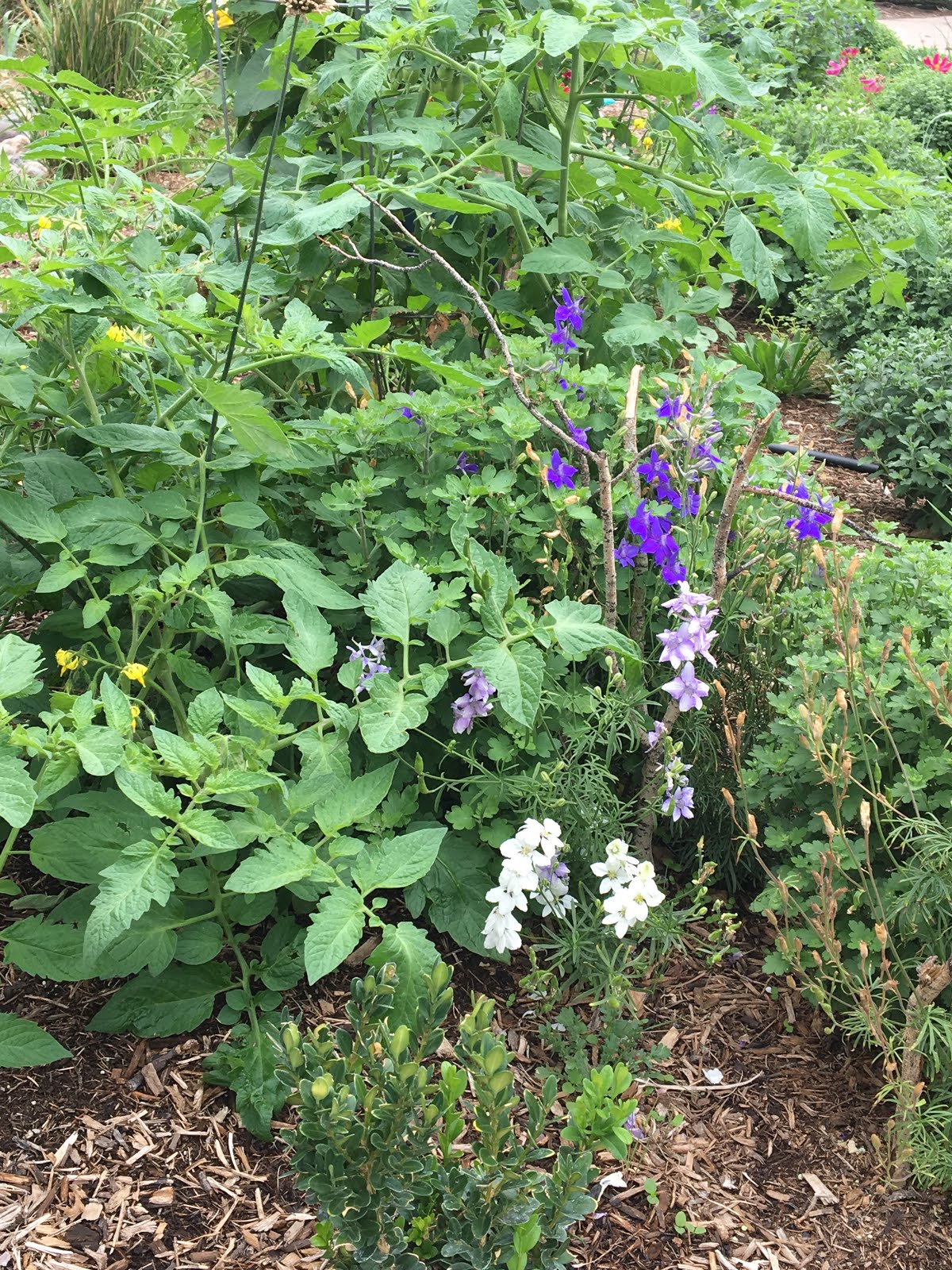
Moving sales and estate sales are especially good for getting garden stuff of all sorts--tools, equipment, pots, and, yes, plants. Especially houseplants, but some outdoor stuff too. I bought a pot of larkspur at a garage sale in Southern California years ago. They seeded all over my yard, and I brought some seed with me to Flagstaff. Here’s the result:


And here's a cymbidium I found at a garage sale in SoCal a few years ago. I wish I still had it. 

Also check out local plant sales. Someone here in Flagstaff has a regular farmstand at her home, where she sells perennials that a) do well in our crazy climate, and b) are cheap. I bought this phlox from her for $1.00 back in May; now look at it!


Forage

I’m going to put a big caveat right up front: obey all laws, and respect private property!

I’ve had good luck foraging for plants in a variety of settings. Here are a few places and strategies that have worked for me:
  • Look for construction sites where old homes are being torn down or natural areas are being paved over. Ask for permission to dig up plants. I did this once in a forest outside of Portland, OR, on a site where a school was being built. I used my acquisitions--ferns, trilliums, and all sorts of other native woodland plants--to naturescape the creek in my backyard. Bonus: the plants didn’t get destroyed when the bulldozers showed up.
  • Forage in the wild. I’m going to repeat the caveat here: obey all laws! In some places, it’s legal to harvest certain species of wild plants from national and state forests. Check with your local ranger station to find out what you’re allowed to take, from where, and how much.
  • Take plastic shopping bags with you. They work better than pots when you’re in the field.
  • Check out trash piles. I snagged a gorgeous yellow rose this way. Someone had tossed their rose cuttings in a pile in the woods, and one of them rooted. There was a lovely yellow bloom standing tall and proud above the pile o’ sticks. I’ve also snagged half-dead potted plants from piles by the curb when people are moving or cleaning. The salvias below were foraged from a curbside trash pile in SoCal. They were in 3" pots when my husband found them, wilted and with soil completely dried out. This picture was taken two years later:

Some caveats

  • Choose plants that will thrive in your conditions - climate, soil, sun, etc. A dead plant is not a bargain.
  • Check any plant you bring home, whether cheap, free or otherwise, for signs of pests and diseases. If your cheapo find infests the rest of your garden with some horrible plague, it’s not a bargain.
  • Beware of accidentally foraging an invasive plant. If it takes over your entire garden and starts manufacturing nuclear weapons, it’s not a bargain.
  • Give back to people who help you. Pay full price once in awhile (if you can) at the nursery that lets you have stuff for free, take a plate of cookies to your generous neighbor, etc. Being a cheapskate is not the same as being a mooch. Sometimes good customers also get sweetheart deals. These are peaches from a peach tree our local nursery in SoCal gave us. It had some wind damage but was perfectly healthy. We bought most of our plants from them and had them help us with some landscaping, so they were generous with us in return. This was an $80 tree.  


Good luck, fellow cheapskates! May your bargains be many, and your grasshoppers be few.

Sunday, May 14, 2017

Cheapskate gardening 1: Propagating plants

Photo from Flickr user mannewaar. Creative Commons licensed.
For much of my gardening life, I’ve had a large yard and a small budget. Sound familiar? Yeah, I thought it might--especially the small budget part. That seems to be an issue for a lot of us. Food gardening in particular tends to get more popular during hard economic times, but you won’t save money if it costs more to garden than to forage at the local grocery store. So let’s talk about how to garden less-expensively. This post will be the first of several, written on no particular schedule, that talk about how to be a frugal gardener. Since spring is in full swing, let’s start with how to save money on plants.

Plants are expensive. Every time I go to my local nursery, I wish I were in the nursery business. I’m pretty sure they must use gold-plated potting soil or something. (OK, nursery people, put down the garden forks. I know it costs lots of labor to produce a beautiful plant and grow it to market size. Really I do. But nursery prices still strain my budget.) So, let’s look at some ways to avoid paying top dollar for the plants you want. This first post will cover plant propagation. The next one will cover other ways to get cheap--or even free--plants.


If you’re willing to do some of the work that nurseries do, you can save lots of money. Go to your local library or flex your Google muscles to learn about plant propagation techniques. Most are not difficult; they just take a little time and know-how. I’ve listed a few techniques and links to articles to get you started, but dig deeper (garden pun alert!) to learn more.


Start them from seed. I’m planning another post on how to grow from seed frugally, so stay tuned for that one. For now, I’ll say that even if you pay full price for seeds at the most expensive nursery in town, starting seeds is going to be cheaper than buying plants.


Take cuttings. You don’t need a degree in botany to grow plants from cuttings. Let’s look at some options:
You can also start plants from offsets--mini-plants that grow from the original, like those cute mini-spider plants that dangle from the mother plant. Just pinch it off and stick it in wet dirt, and soon you’ll have a new plant. True story: The only thing I ever deliberately stole from a store was an offset from a spider plant. I was probably about 10 or so and had fallen in love with houseplants (gardeners, like serial killers, often show signs of their pathology at an early age). I had very little money, but I would stroll through the houseplant aisle at the local Value Giant and look longingly at the pretty green wares. One day temptation got the best of me, and I pinched off a tiny offset from one of the big, beautiful spider plants, took it home, and planted it. It grew, and I had the plant for years, though I’ll admit to feeling a twinge of guilt whenever I looked at it.


Try layering. Layering is similar to taking stem cuttings, but the piece to be rooted remains attached to the parent plant while it’s rooting. See articles from Gardening Know How and NC State Extension for clear, detailed instructions. GrowVeg has a great post on propagating herbs and other edibles via layering.


Propagate by division. Division is the easiest propagation method I’ve ever tried. It works with plants that form clumps, bulbs, suckers, tubers, or rhizomes (so basically perennials that have more than a single stem, because you have to have something to divide).  It consists of 3 basic steps:
  1. Dig up the plant.
  2. Cut it into pieces.
  3. Replant the pieces.
OK, so there’s a little more to it, like knowing what time of year works best for a specific plant and the best days to do it (hint: not when it’s 112F in the shade). Bay Gardens has a list of plants that can be propagated by division with recommended times of year. Seasonal Gardening offers more detailed instructions for those of you who liked to do all the optional reading in school.


Propagate stuff you get from the supermarket. When I was a kid (Oh, no! There she goes with another story about back in the day…), my mom seemed to always have an avocado pit suspended from toothpicks in a plastic cup filled with water. And it was always on the kitchen windowsill. It looked just like this, except after about 2 weeks it was coated with green algae.


Photo from Wikimedia Commons. Creative Commons licensed.


I don’t ever remember any of those pits actually germinating, but they were there, by golly. I’m pretty sure there was a law in California in the 1970s that said you had to have an avocado pit in your kitchen window.


Turns out there are lots of things you can grow from grocery store produce (besides algae avocados)--so many that people have written entire articles and even books on the topic. See this article from the Missouri Botanical Garden for a good starting point. A few words of advice from my own experience:
  • You’ll find lots of information warning you about what not to do. Don’t propagate [thing] because it’s been treated to inhibit sprouting/it’s not organic/it will explode on contact. OK maybe not that last one. But you’ll hear the other two a lot. I’m not going to get into the “organic vs. not organic” debate except to say that if you’re not dumping pesticides on it, your homegrown version will probably be healthier than conventionally-grown produce. So I’d worry less about what you started with that what you do with it after it’s in your yard. As for the bit about being treated to inhibit sprouting: I put old potatoes and onions in my yard after they sprout, so it’s not really a problem. (If they haven’t sprouted yet, I’m probably going to eat them). And I’ve grown garlic and shallots from supermarket stock many times with no issues. So don’t be afraid to ignore the naysayers and give it a try.
  • Fruit grown from seed (like the aforementioned avocado) can work, but don’t expect any fruit for several years, and don’t expect the fruit to be like the stuff you buy at Safeway. But if you want to do it for fun, go for it. Citrus is especially easy to start from seed.


OK, so I’ve directed you to a bunch of online resources. But does any of this actually work? Yes. Yes it does. I’ve started lots of stuff from cuttings: mint, basil, roses, citrus trees, rosemary, the pilfered spider plant, and probably a ton of other stuff I’ve forgotten. I dig and divide perennials like Shasta daisies and irises all the time, and I’ve started blackberries through layering. Instead of composting my onions when they sprout, I’ve started sticking them in the garden, regardless of the time of year, then using the tops as green onions. This year I stuck an old yellow onion in the ground in late winter. It has survived multiple hard freezes and snowfalls and is now sending up a bloom stalk. Onions are tough.


Propagation can be fun, and it’s especially satisfying to grow plants you’ve propagated yourself. Plus, it gives you bragging rights when your fellow green thumbs come over. “Oh, that? Yeah, I grew that from a cutting I got from my great-grandma. The original plant came over with my ancestors on the Mayflower.” Don’t forget to include a casual flip of the hand, as though this is an event so routine in your life that it barely warrants mentioning. Then you can be both a cheapskate gardener and a snob.


You’re welcome.

Tuesday, November 22, 2016

The virtues of scrounging

One of the things I learned from my father1 was how to be a good scrounge. Scrounging or scavenging gets a bad rap in our culture; it’s seen as a sign that you’re poor or desperate or lack the dignity to go to the store on Black Friday and club other shoppers over the head with truncheons like everyone else does. I disagree. Baseball bats are cheaper than truncheons. Also, I see scavenging as a mark of intelligence and resourcefulness. Why pay retail for something you can scavenge for free? Certainly there are exceptions to that rule (condoms and dirty underwear come to mind), but there are 3 big benefits to scavenging, two personal and one environmental:
  • You can save lots of money.
  • Figuring out how to get stuff without spending (much) money or how to reuse stuff no one else wants stimulates creativity and ingenuity. My parents, especially my dad, grew up during the Great Depression. My dad’s family were Okies who lost everything in the Dust Bowl years and migrated to California, Grapes-of-Wrath style. They were dirt poor, so they learned to make do with the little bit they had in order to survive. That sucked, and I don’t intend to romanticize that kind of poverty (The only people who romanticize poverty are those who’ve never experienced it). But it did have one benefit: learning to make do, being creative about solving problems with what they had.
  • Scavenging is good for the environment. You can keep stuff out of the landfill by reusing it. And if you’re scavenging for your garden, you’re reusing stuff to help you grow stuff, which should make your local insufferable-patchouli-coated-locavore-who-composts-his-own-poop bow in your general direction. Just make sure you stay upwind of his compost pile.

It’s easy to find uses for stuff when you’re a gardener. Here are just a few examples of stuff I’ve scavenged:

Plants. Lots of ‘em. Probably my favorite example is the three salvias that my husband found discarded at the curb on trash pickup day in Southern California. He’s also a veteran scrounge, so he brought them home. They looked mostly dead, but remember what Miracle Max said about being mostly dead? I watered them, and they came back. I planted them, and they flourished. I didn’t even need a Miracle Pill. That's them in the foreground of this pic:


We’ve also dug up plants from old housing sites and natural sites that were being bulldozed (all with permission of course). I naturescaped a creek bank in Portland with trilliums and other woodland plants salvaged from a forested site that was being bulldozed to build a school. Those plants would have cost a fortune at the nursery; meanwhile the ones on site would have been destroyed. And of course I’m not shy about asking for cuttings from people’s yards.

Organic matter. When I have new beds to build, or I need inexpensive organic mulch, I ask people for grass clippings (if the grass hasn’t been treated with herbicides). I’m on a pile of bagged leaves at the curb like jawas on a burned-out village on Tatooine. Pine needles are plentiful here, so I grab those too. I answer ads on Craigslist for free manure2. I offer to haul away people’s straw bales after Thanksgiving. Just last weekend, we bought some hay for our goats, and the feed store person offered us a big broken bale for free. The goats got some, and my compost bin got the rest. My husband was hauling a load of trash to the dump (no, we don’t reuse everything). He saw a guy there with a load of spoiled straw bales. The guy agreed to deliver them to our house instead, and I’ve been using them for mulch for the last 2 years. There are still about 6 left.

Landscape material. The free ads on Craigslist are a gardener’s gold mine. People give away rocks, soil, landscape timbers, railroad ties, fencing, and just about anything else you might want to put in a yard. I use cardboard as a sheet mulch, so I scavenge cardboard sheets from my local Sam’s Club. I’m not sure why they find it necessary to put a thin piece of cardboard between those 55-gallon drums of mayonnaise, but I’m glad they do.

Seeds. I’ve been known to ask people if I can collect seed from plants in their yards, and I’ve also been known to carry envelopes in the car for exactly that purpose (Girl Scout motto: Be Prepared). I got a huge white pumpkin for almost free at Home Depot on Halloween, not because I needed the pumpkin, but because I wanted the seeds. I don’t know if they’ll come true from seed--that monster might be a hybrid, or possibly the product of a nuclear accident--but I’ll take a chance and see. That's it on the far left in the photo below. I'll be butchering it this weekend for its seeds, because I'm ruthless like that.


I saw a cool warty pumpkin in a bin at Safeway just before Halloween that had rotted into a slimy mess. I asked the produce manager if I could have it. He seemed glad to be rid of it; I can’t imagine why (But the look on his face when I asked for it was priceless. That’s another benefit of scavenging: free entertainment.). I’m pretty sure it’s an heirloom, so it should grow true from seed. Digging the seeds out of the slime was a nasty job--thank goodness for latex gloves--but it’ll be fun growing some new pumpkins next summer from seed I didn't have to buy.

Crops. I canned 13 quarts of apple pie filling a few weeks ago, all made from apples we picked from a local dentist’s office. They have several trees on the property and don’t use the apples, though I'm sure they'd be horrified at the amount of sugar I dumped into the pie filling. You know, they're dentists. We’ve gotten permission to pick fruit from people’s yards a few times too.

So ignore the snobs and the stigma and get busy scrounging! You’ll have a bigger, better garden, the thrill of the hunt, and the satisfaction of getting something useful for free while doing your bit for the planet.

---------------


  1. Besides the First Law of Thermodadnamics: “Close the damn door! I’m not paying to heat the whole outside!” Dad would have loved global warming.
  2. “Happier than a gardener in shit” is one of my favorite expressions. And of course, shoveling manure is a shitty job, but someone has to do it. Manure jokes: even shittier than Dad jokes. Sorry if my language offends; we gardeners are an earthy lot. Thank you, thank you, I'll be here all week.