Pages

Saturday, September 2, 2017

Cheapskate gardening 2: How to get plants cheaply (or even free)

In my first cheapskate gardening post, I wrote about propagating plants and included lots of links to online resources to help you get started. In this post, I’ll talk about other ways to save money on plants.

Get ‘em on sale (or free!)

Here in the land of early frosts and negative winter temperatures, the big box stores and nurseries are already starting to clear out their stock, so we cheapskate gardeners can score big. For example, last weekend I got three 1-gallon Japanese maples from Home Depot for $7 each. They’re regularly something like $39.99. (Note to Flagstaff gardeners: these are still on sale at this price. Go get ‘em!) Today I snagged a 1-gal Russian sage for $2.98 and a 1-gal clematis ‘Jackmanii’ for $6.98. Last year’s haul consisted of 1-gal evergreen shrubs (boxwood, euonymous) for $1.98 each, 4” chrysanthemums for $.50 each, and 6-packs of pansies, violas, and snapdragons at buy 1 get 10 free (no, that is not a typo). It takes a bit of luck and persistence, because once something goes on closeout, it tends to sell out quickly. I try to check at least one big box store every weekend in the late summer and fall (yeah, OK, I visit every big box store, nursery, and any other establishment that ever considered selling a plant pretty much every weekend. I need therapy.) Start paying attention to what goes on sale when; it’s worth it. Sometimes the stuff you get will be winter-hardy, just getting a bit pot-bound and shabby-looking. Sometimes they’re annuals that will need winter protection. Also watch for stores clearing out their bare-root stock in late spring, but check the packages carefully; many bare-root plants die before the store closes them out.

Here's some of those buy-one-get-10-free violas, which wintered over nicely in containers on my porch and were then moved out into the garden.


Sometimes stores will mark stuff way down that’s past its prime or, on rare occasions, let you have stuff free. Always check what I call the sad sack rack, the clearance rack of plants that need a little TLC or maybe have just passed their bloom time. Last weekend I made the mother of all scores, 13 pink Knockout roses at Home Depot--absolutely free. They were tossed in a shopping cart, so my husband (who’s way more brazen than I am), asked if they were throwing them out and, if they were, could we have them. Much to my surprise, they said yes. This doesn’t always work, because sometimes the grower requires the store to certify that the plants have been destroyed in order to refund the store’s original investment. But it’s worth a shot.

Buy 'em small


Smaller plants are cheaper than larger plants, because the grower has invested less time, water, and fertilizer into their care. Often the smaller plants will adjust to transplanting faster and catch up with their larger brethren quickly. Know the plant and its growth rate, and if you don’t need the giant specimen right now, get the smaller one. Bonus: buy perennials bare-root when you can. Bare-root perennials go on sale in late winter to early spring and are generally ⅓ to ½ the cost of the potted versions you’ll see later in the season.

Trade

Trading plants is easy and fun--and it’s a great way to meet other gardeners. I’ve traded in a few different ways: trading with neighbors, via my local gardening group on Facebook (a local in-person gardening club would work well for this too), and online. Just today I traded some of the free roses I got from Home Depot and a peony I grew from bareroot stock on closeout--plus some Sacred Datura that volunteered amid my vegetables--for some strawberries, penstemon, and nodding onions. Learn to propagate (see my first post in this series), and you’ll always have stuff to trade. Try the Gardenweb forums to find online traders. Look for a forum with, “Exchange,” in the name. Offer to help a neighbor dig and divide perennials in return for a few. That’s an especially kind thing to do for someone with physical limitations. Note: I once acquired about 8 rose bushes from a neighbor who wanted them cleared out of his backyard. I did the digging and hauling, which saved him a bunch of effort and netted me a new rose garden. Yay!

Here's a bloom from one of those roses:


You can also host an in-person plant swap. I’ve always wanted to do that. Google “how to host a plant swap” for a bunch of articles telling you, well, how to host a plant swap. Then invite me!

Hit those garage sales

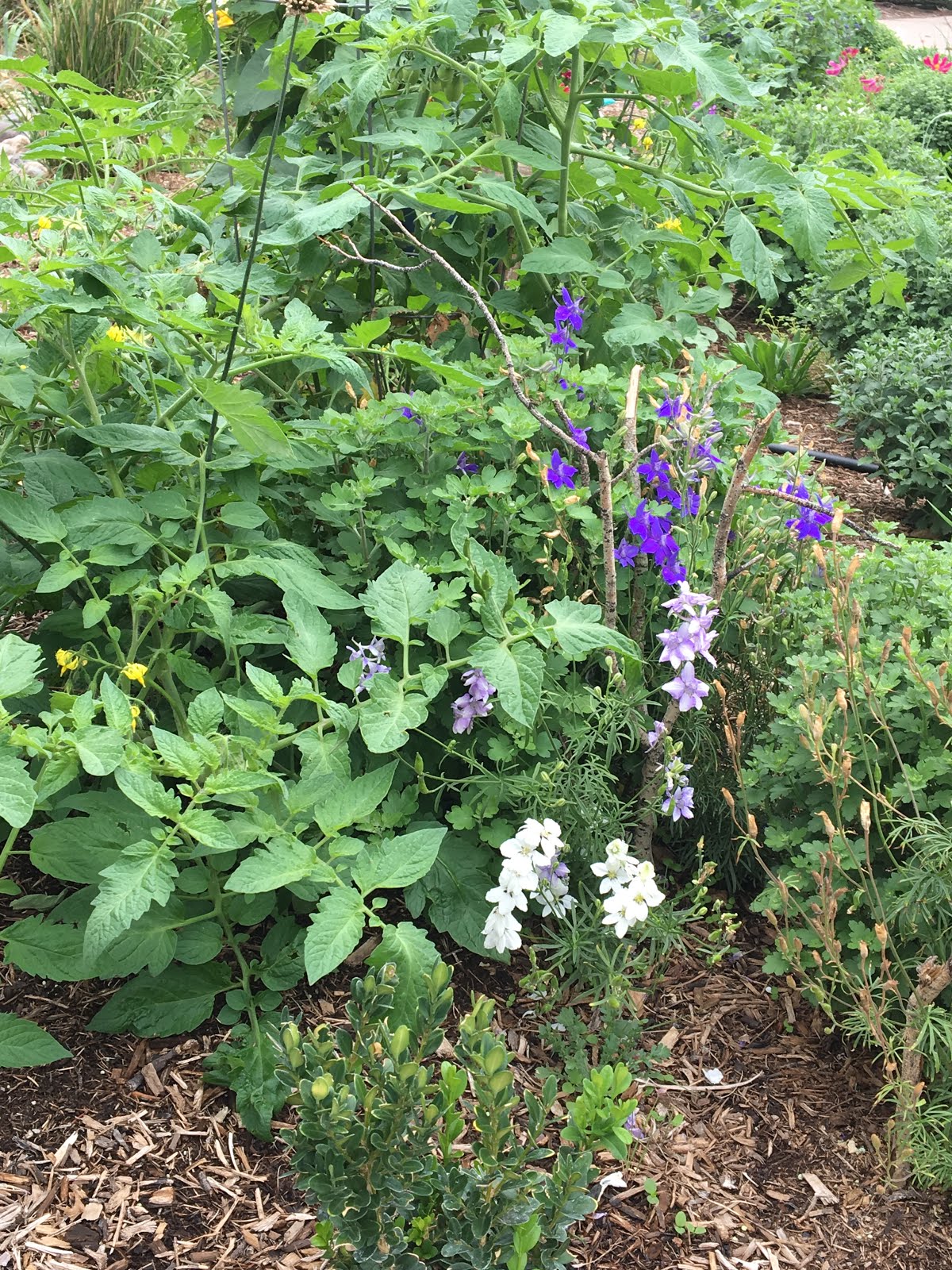
Moving sales and estate sales are especially good for getting garden stuff of all sorts--tools, equipment, pots, and, yes, plants. Especially houseplants, but some outdoor stuff too. I bought a pot of larkspur at a garage sale in Southern California years ago. They seeded all over my yard, and I brought some seed with me to Flagstaff. Here’s the result:

And here's a cymbidium I found at a garage sale in SoCal a few years ago. I wish I still had it. 

Also check out local plant sales. Someone here in Flagstaff has a regular farmstand at her home, where she sells perennials that a) do well in our crazy climate, and b) are cheap. I bought this phlox from her for $1.00 back in May; now look at it!


Forage

I’m going to put a big caveat right up front: obey all laws, and respect private property!

I’ve had good luck foraging for plants in a variety of settings. Here are a few places and strategies that have worked for me:
  • Look for construction sites where old homes are being torn down or natural areas are being paved over. Ask for permission to dig up plants. I did this once in a forest outside of Portland, OR, on a site where a school was being built. I used my acquisitions--ferns, trilliums, and all sorts of other native woodland plants--to naturescape the creek in my backyard. Bonus: the plants didn’t get destroyed when the bulldozers showed up.
  • Forage in the wild. I’m going to repeat the caveat here: obey all laws! In some places, it’s legal to harvest certain species of wild plants from national and state forests. Check with your local ranger station to find out what you’re allowed to take, from where, and how much.
  • Take plastic shopping bags with you. They work better than pots when you’re in the field.
  • Check out trash piles. I snagged a gorgeous yellow rose this way. Someone had tossed their rose cuttings in a pile in the woods, and one of them rooted. There was a lovely yellow bloom standing tall and proud above the pile o’ sticks. I’ve also snagged half-dead potted plants from piles by the curb when people are moving or cleaning. The salvias below were foraged from a curbside trash pile in SoCal. They were in 3" pots when my husband found them, wilted and with soil completely dried out. This picture was taken two years later:

Some caveats

  • Choose plants that will thrive in your conditions - climate, soil, sun, etc. A dead plant is not a bargain.
  • Check any plant you bring home, whether cheap, free or otherwise, for signs of pests and diseases. If your cheapo find infests the rest of your garden with some horrible plague, it’s not a bargain.
  • Beware of accidentally foraging an invasive plant. If it takes over your entire garden and starts manufacturing nuclear weapons, it’s not a bargain.
  • Give back to people who help you. Pay full price once in awhile (if you can) at the nursery that lets you have stuff for free, take a plate of cookies to your generous neighbor, etc. Being a cheapskate is not the same as being a mooch. Sometimes good customers also get sweetheart deals. These are peaches from a peach tree our local nursery in SoCal gave us. It had some wind damage but was perfectly healthy. We bought most of our plants from them and had them help us with some landscaping, so they were generous with us in return. This was an $80 tree.  


Good luck, fellow cheapskates! May your bargains be many, and your grasshoppers be few.

Saturday, August 12, 2017

A bounty of beauty

It's been a tough few days. I want this blog, like my garden, to be a respite from the rest of reality, so I'll skip the details. Suffice it to say that there are a lot of horrible things happening in the world right now. So I've taken every opportunity to find peace in the garden. For once I haven't done a lot of actual gardening, though I did manage to pull a few weeds and extend my new path a few feet. Mostly I've tried to just be in the garden, to notice beauty both large and small, to watch the bees and butterflies, to savor the exuberance of life in the summer garden (except for the grasshoppers. I could do without their exuberance.) I took these pictures yesterday as I was enjoying some horticultural therapy. One of the best things about being a gardener is that beauty is so easy to find: it's right outside the door.

Blue Mist Spirea 'Dark Knight' - just started blooming this week.


Here's part of the side garden. The ornamental grass also just started blooming this week. Last year I left it standing through the winter; those plumes looked so cool sticking out of 2 feet of snow.


Petunias and purple alyssum - such a pretty combination. And in case you're wondering about the bites taken out of the petunia petals, you can blame the grasshoppers for those. Apparently they find flowers delicious.


Wanna know something else that grasshoppers find delicious? Cosmos! I got these at the nursery about a month ago, and the grasshoppers ate most of them down to the stems. Most of them came back, though, and they're lookin' good.


I think I posted a pic of this chair a couple of weeks ago - back when you could tell it's a chair. The morning glories have mostly covered it now, and they're starting to bloom. And yeah, it looks like the grasshoppers think morning glory flowers are delicious too. Bastards.


Another favorite on the grasshopper menu: bachelor buttons. For a couple of months, the stems of my bachelor buttons were bare, stripped clean by those hopping marauders. Some of them are coming back though, and this little clump looks mostly healthy.


Bee balm, winter-sown and planted in my newest whiskey barrel planter.


I think I'm in love with larkspur. The grasshoppers mostly ignore it (a miracle), and it's been blooming since May. These were winter-sown from seed I brought with me from Southern California. I bought a pot of them at a garage sale, and they proceeded to seed all over my SoCal garden. I hope they do the same here.


The bog is a jungly mess, partly because of string algae and partly because I scored some water plants for 50% off at my local nursery last week. Gotta love Flagstaff, where end-of-season sales start in early August. Tomorrow's project--if the rain stops long enough--will be to repot my finds and put them somewhere in the main pond.


More string algae. Bleah. But also a water lily, some water hyacinth, and at the left, some water mint. I didn't know water mint existed until this year. I bought some cuttings from a nursery in Las Vegas, and they rooted in just a few days. Now I have several clumps of this charming plant, and it's even blooming. And yes, it's a true mint. I'm told you can cook with it but that the terrestrial mints taste better.


This pic shows the area of the yard that's mostly not landscaped yet. I've started clearing a path to the arbor, which you can see if you look closely, and I've lined the walkway with rocks so I can raise the soil level by adding lots of organic amendments. Then I'll create some winding paths and more planting beds to feed my ever-growing addiction.


This is the Devil's Trumpet (also called Sacred Datura) growing at the base of the M*A*S*H* sign. I got it from the Flagstaff Arboretum's native plant sale a couple of years ago. It's been left without water, eaten down to the stems by tomato hornworms, and accidentally buried when we were digging the pond, but it keeps coming back. And now I have a bunch of seedlings sprouting all over my yard.


Aren't the blooms gorgeous? I hope to relocate some of the volunteers to various neglected corners of the property, since these things will grow anywhere and (as I've demonstrated) virtually impossible to kill.


And last but not least: I bought a 6-pack of portulacas, because the ones I winter-sowed didn't survive. These have flourished. They tolerate dry, poor soil, the grasshoppers don't like them (another miracle), and they keep pumping out these gorgeous blooms.


I feel better just posting these pics and writing about plants. Perhaps I should have titled this post, "Gardening: It's Cheaper Than Therapy." Now if only I could get my health insurance to pay some of the cost...

Sunday, July 30, 2017

State of the garden report: midsummer

Monsoon season has been going strong for nearly a month here in the high desert. In fact, I think we’ve had maybe 1 day without rain since early July. This is my fourth monsoon season here. It seems like we had more big storms in previous years--pounding rain, hail, and wall-shaking thunder that turns Fritz the Cowardly Greyhound into a quivering, foaming-at-the-mouth wreck. We’ve had some of that this year, but we’ve also had more cloudy-as-Portland-in-February days and more extended periods of lighter rain. On the upside: I haven’t had to water since early July, the garden is lush and healthy, and grasshoppers go into hiding when it rains. On the downside: I keep getting rained on when I try to plant or weed. On the whole, though, I’ll take it. Check out this tangled jungle of wonderfulness.

Pond and bog

I still have tons to do to clean up the pond site and landscape around the edges, but it’s starting to look less like an excavation and more like a water garden.

The shallow area on the right with all the plants in it is a bog filter. It has about 8” of pea gravel in it. Underneath is a PVC pipe with holes in it. The main pump pumps water into the PVC, so the water is pushed up through the gravel (kind of the reverse of an undergravel filter in an aquarium). The fish waste nourishes the plants, which feed on the nitrates that would otherwise bother the fish. Want one? Of course you do! Instructions are available from Nelson Water Gardens.


Ranuculus flammunla, a/k/a Small Creeping Spearwort. This was one of the first pond plants I bought, and it has thrived from day 1 in the bog.

The cute little lavender flower is a bloom on my water mint. I got some cuttings of water mint from a nursery in Las Vegas. Like most mint, it rooted easily in water (duh) and is happily spreading around the bog.

At the east end of the pond, I built a new bed. It’s not really part of the pond, just adjacent to it. Right now it’s a tangled mess. The weedy thing with the white flowers is horsetail milkweed, our (rather ugly) native milkweed. It volunteered there (and a bunch of other places in my yard), and I left it to lure in the monarch butterflies. We had a couple in the yard yesterday, but unfortunately I didn’t have a camera handy. The rest of the mess is Mexican Hat (Ratibida columnifera), one of our native wildflowers that I winter-sowed, plus a tomato plant, a lilac, portulaca, petunias, Gerbera daisies, and some winter-sown penstemons that should bloom next year.


Side cottage garden
Here’s most of the length of the side garden. Those round green things are the chrysanthemums I bought for $.50 each at Wal-Mart last fall. They were in 6” pots then. Almost all of them lived through the winter and look quite happy.


Fuji apple, tomato, mums, chair planter, and a few other things:

Chair planter with dianthus and society garlic in the pot and morning glory trying to take over the known universe:

Columbine:

Violas and pansies. They’ve been blooming since early spring and show no signs of slowing down. I got these at a buy-one-get-10-free sale (really!) late last fall at Home Depot and wintered them over in a warm-ish corner of my front porch.

Pansies, flat-leaf parsley, and purple alyssum. I winter-sowed the parsley and alyssum.

An attention-loving petunia photobombing the alyssum:

Hollyhocks are slowing down a little but still pretty.

The rusty wrought iron kitty is now blue! Hubby painted it for me last night. I love how this shade of blue pops in the garden.

Echinacea, Shasta daisy, and a tomato. I tried using a piece of yard art in lieu of a tomato cage. So far so good, but I think that’s only because the tomato in question is still small.

Similar to the pic above, but in this one you can see the catmint as well. It’s in one of the dryest, most inhospitable parts of the bed, with lousy soil and a bench blocking morning sun. Yet it has been thriving for the last couple of years with almost no attention, and it’s pretty, and the bees love it. Yay for low-maintenance pollinator-attractors!

Front door cottage garden
Note for the uninitiated: In this case, “Cottage garden,” is a synonym for, “jumbled up mess created by a gardener who can’t design her way out of a wet paper bag.” I’m a proud member of the, “Stick it somewhere and see how it looks when it’s bigger,” school of garden design.

Jungle of tomatoes, mum, and what’s left of the gorgeous, frilly pink peony poppy I winter-sowed this year:

Welcome to the jungle. I do think the purple larkspur looks pretty growing through the tomatoes.


Black cherry tomatoes. I think they look like giant deadly nightshade berries (For you wiseasses in the crowd, yes, I know tomatoes *are* nightshade berries. Thankfully they aren’t deadly.) I love how these look on the vine. Hopefully they’ll taste as good as they look.

Look! A tomato that’s almost ripe! (A Sungold, to be specific.) And it isn’t even September! And it’s on the vine, not in a paper bag in my spare bedroom sometime after the first frost. Someone alert the media.

Container garden

The pansies, violas, snapdragons, and alyssum were all purchased last fall when Home Depot was clearing out their annuals for winter. This corner of my front porch is sheltered by the house on the south and east sides and stays at least a zone warmer than the rest of the garden. I threw a frost blanket over the whole area when nights got below the mid-20s. As you can see, they came through the winter just fine, and they’ve been blooming since about March.

Here’s a side view showing the succulents I got from Home Depot for free when they were being thrown out last summer. Home Depot rarely gives old plants away; I got lucky that day. These wintered over indoors.

I tried growing some tomatoes in containers this year, so I could put them up against the south wall of the house and (hopefully) actually get them to ripen. The 2 on the right have tomatoes on them and are doing well. The Brandywine on the left appears to have an issue.

The potager

Note for the uninitiated: “Potager,” is a French kitchen garden that combines vegetables, herbs, fruit, and flowers. I call mine a potager, because I have delusions of grandeur. In my defense, this garden was built just last fall and this spring and isn’t finished yet. I really do want to make it look like a (low-budget) potager, but that may take awhile. Right now it’s as jungle-like as the rest of my yard and infested with a number of large and occasionally interesting weeds. I’m thinking of nailing my, “Martha Stewart doesn’t live here” sign (yes, I really have one) to the top of the arbor at the entrance.

The red cabbage is ready to harvest. It’s about to become Asian slaw.

The bed on the left is supposed to contain winter squash, cantaloupe, bush beans, and sunflowers. The winter squash, cantaloupe, and sunflowers are there, but so is a huge volunteer Datura wrightii (a/k/a Jimson Weed or Sacred Datura). Let’s have a deadly poisonous plant growing among stuff we plan to eat. What could possibly go wrong? Yeah, I need to move it, but it has buds on it, and it’s going to look beautiful when it blooms. The bed on the right contains my fennel. The fennel I fantasized about eating in a nice salad with a lemon vinaigrette dressing. I love fennel. My whole family loves fennel. And there it is, tall and healthy. There’s just one problem: no bulbs. Nope. None. The seed packet says it’s a bulbing variety, but apparently the plants didn’t read the seed packet. Oh, well--at least the pollinators love it.

Here we have a bed of potatoes and bush beans, along with the one calendula I winter-sowed that actually germinated and grew. The beds next to the (badly-built, not fully-painted) fence contain Bright Lights chard that bolted, lettuce that bolted, a currant bush that the grasshoppers have been dining on, onions, cucumber, and a giant winter squash that appears to be trying to invade the neighborhood.

I’ll close with one final pic. This one is looking out toward the edge of the potager and the pasture. The M*A*S*H sign (you young’uns can Google it) was custom designed by my husband. It includes many of the places used on the sign in the TV show, plus several that have meaning for us: our hometowns, Hogwarts, Sheffield (for anyone new to dealing with me, I’m a diehard Def Leppard fan), and a few others. It used to be in what is now the middle of our pond, but we moved it. We’re just starting to landscape this area of the yard. It’s mostly weeds now, but that should change in a few years.